


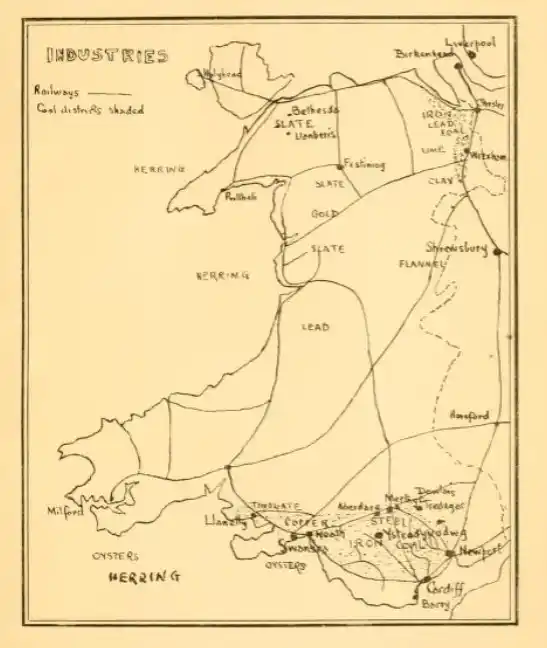
 Map showing historical industries of Wales in Owen Morgan Edwards' A Short History of Wales published 1907, accessed via the Internet Archive
If you're keen to trace family in Wales, read our guide to find useful tips, websites, research know-how and records to help you trace your Welsh ancestry.
Researching ancestors in Wales provides unique research opportunities. Read on to find out about the key record collections to help you, and useful research advice to help you succeed in tracing your Welsh family tree.
The National Library of Wales website
Birth, marriage and death records for Wales
Welsh place names glossary & list
How to find family history societies & associations in Wales
Find out more about Welsh history: watch and listen…
Useful Welsh words for family history research
The significance of patronymic names
Emigration – seeking 19th C Welsh emigrants
Read up on it: Genealogy guide to Welsh ancestors
Beryl Evans’s book Tracing Your Welsh Ancestors, first published in 2015 and last released in 2025, is a comprehensive, authoritative guide to tracing ancestors in Wales
Expert advice from Beryl Evans, research manager at National Library of Wales, and author of the book Tracing Your Welsh Ancestors:
When researching Welsh family history, people are daunted by the lack of surnames especially if they are looking for Jones, Davies Evans etc.
- My tip is to look at the larger picture – for instance, any siblings with unusual names. Try working back from them to the previous generation.
- Look at and compare occupations of those with same names.
- Also in the same way look at places of abode, as the names of property can eliminate a possible candidate.
Using a combination of all three details will hopefully put you on the right branch of your tree!
The National Library of Wales website
Find visiting information at https://www.library.wales/visit
The National Library of Wales website is an astonishing treasure trove of Welsh heritage. From historical facsimile documents to invaluable family papers, there are a wealth of resources to learn from, such as:
- 300,000 entries from the Tithe Maps of Wales
- Runs of 50 different Welsh journals
- 1.1 million Welsh newspaper pages
- 5,000 life stories in the Dictionary of Welsh Biography
- Wills pre-1858
- Plus collections such as 4,000 Welsh ballads, crime and punishment 1730-1830, marriage bonds pre-1837, vintage video clips and so much more!
Plan your visit to NLW: Find useful information to help you plan your trip to the National Library of Wales in Aberystwyth here.
The census for Wales
The census for Wales is available for researchers to explore in the following years: 1841, 1851, 1861, 1871, 1881, 1891, 1901, 1911 and 1921. You can access these online (£) at Ancestry, FindMyPast, and MyHeritage. Note: The 1921 Census for Wales is also free to view at The National Library of Wales, in Aberystwyth (and at the National Archives, UK and Manchester Central Library).
Professional genealogist Fiona Gray-Davies (of more below) reminds that: 'Census records can also provide evidence as to whether your ancestors spoke Welsh. Since 1891 the census in Wales has included a question asking whether people could speak English, Welsh or both'.
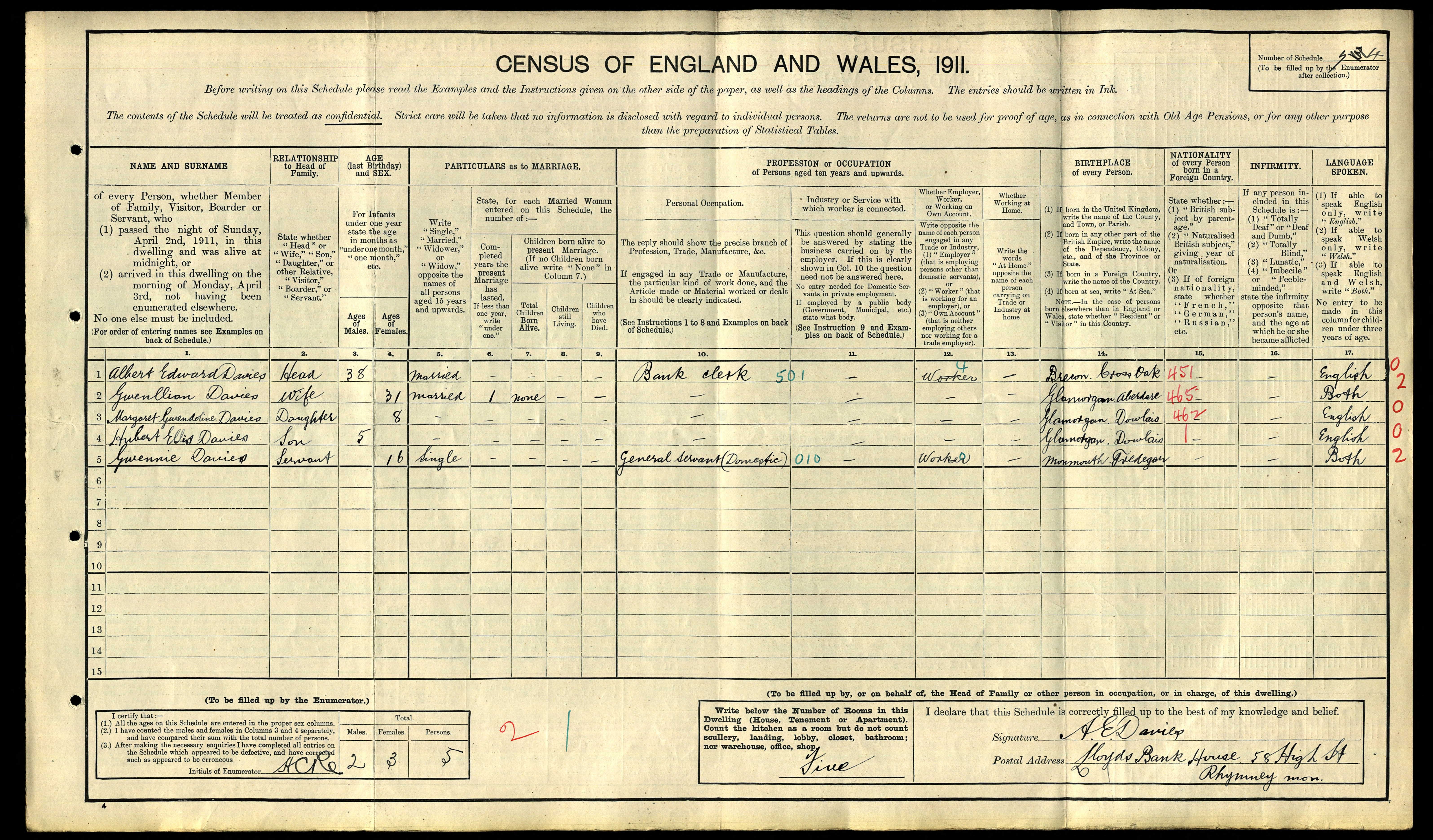
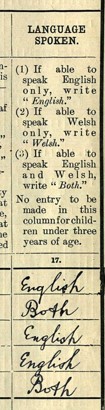
Examples from the 1911 Census for Wales showing the lanuages spoken details, recorded on the far right-hand side of the householders' schedule. Images published with permission of Findmypast.
Birth, marriage and death records for Wales
- The National Library of Wales is home to copies of the General Register Office (GRO) indexes of Welsh births, marriages and deaths from 1 July 1837 onwards (please note that the library does not hold or issue certificates). At the library, you can access microfiche copies of the indexes from 1837 to 1998, and also access FreeBMD, FindMyPast and Ancestry online indexes free of charge.
- North Wales BMD is another useful resource: an ongoing project by Welsh family history societies to make available the indexes of births, marriages and deaths from the local register offices of North Wales (as opposed to the GRO indexes) from the start of civil registration in 1837.
Parish records for Wales
Welsh baptisms, marriages and burials recorded within church records are useful for tracing your family tree back before the start of civil registration (ie before 1 July 1837). Parish registers continued to be kept after this date too.
- The original registers are kept by county record offices around Wales, which are listed, for instance in the FamilySearch Wiki on Record Offices In Wales.
- The National Library of Wales has records for more than 500 parishes on microfilm on open access, as well as transcripts and indexes of various parish registers made by family history societies, and online collections of parishes registers (some digitised images of originals, and some transcripts and indexes) accessible via Ancestry, FindMyPast, TheGenealogist, MyHeritage and FamilySearch - so do be sure to check what's available with the sites you already use.
- Bishops Transcripts (copies of parish registers sent to the arch deacon or bishop annually) are also useful to research, to replace or supplement the information found in baptism, marriage and burial records. Again look out for digitised access and check with relevant local archives.
Professional genealogist Fiona Gray-Davies (of more see below) provides the following important points to note:
'By 1851 some 75% of the Welsh population were nonconformist. This means tracing family [parish register] records in Wales can be difficult. Some nonconformist ministries didn’t keep registers and some ceased with the introduction of civil registration in 1837.'
'... many non-conformists would have married in an Anglican church. Post 1837 they could marry within their own denomination provided a registrar was present.
'In 1836 they were asked to hand any [non-conformist] registers over to the Registrar General. The records of those who complied are at The National Archives and available in the nonparochial record collections on TheGenealogist.co.uk'. Search the Non-conformist collections on TheGenealogist.
The 1939 Register for Wales
The 1939 Register for Wales was taken on 29 September 1939 as a head count of the civilian population, for the purposes of identity cards, ration coupons and recruitment, in the opening weeks of the Second World War. For family history purposes it serves a similar purpose to the census, albeit at a very dramatic period of history. The digitised records for Wales may be found on Ancestry, Findmypast, MyHeritage and TheGenealogist. Note that there is a 100-year closure period. ie the details for anyone born within the past century will be redacted, unless proven deceased.
Wills for ancestors in Wales
The wills search web page at The National Library of Wales website allows you to search for wills proved in the Welsh ecclesiastical courts before 1858. If you have a readers’ ticket to the NLW you can log in and view the will online, giving you free access to pre-1858 digital images. Wills can be ordered via the Enquiries link on the web page.
Explore 20+ archives in Wales
Archives Wales is an online gateway to thousands of records held in more than 20 archives around the country. The online catalogue allows you to search archive descriptions, allowing you to locate collections of interest.
Visit https://archives.wales/ to learn about more than 20 Welsh archives and explore the catalogue online
Explore too the Welsh Archive Repositories map.
Historic Welsh place names glossary & list
Learn the meaning of Welsh place names
As a Google search will show, there are dozens of Welsh Place Names glossaries available to help you research a particular settlement. We like this one at Welsh Family History Archive. As its author John Ball explains: many Welsh place names have their roots in extremely descriptive landscape elements and so if you delve into the history of the name, you might well come to discover much about what life was like there when it was your ancestor’s home.
Discover the locality of historic Welsh places
The List of Historic Place Names contains hundreds of thousands of place names taken from various historical sources, and is extremely useful for pinpointing smaller towns and villages. You can search by specific place name, or browse different places using the maps feature.
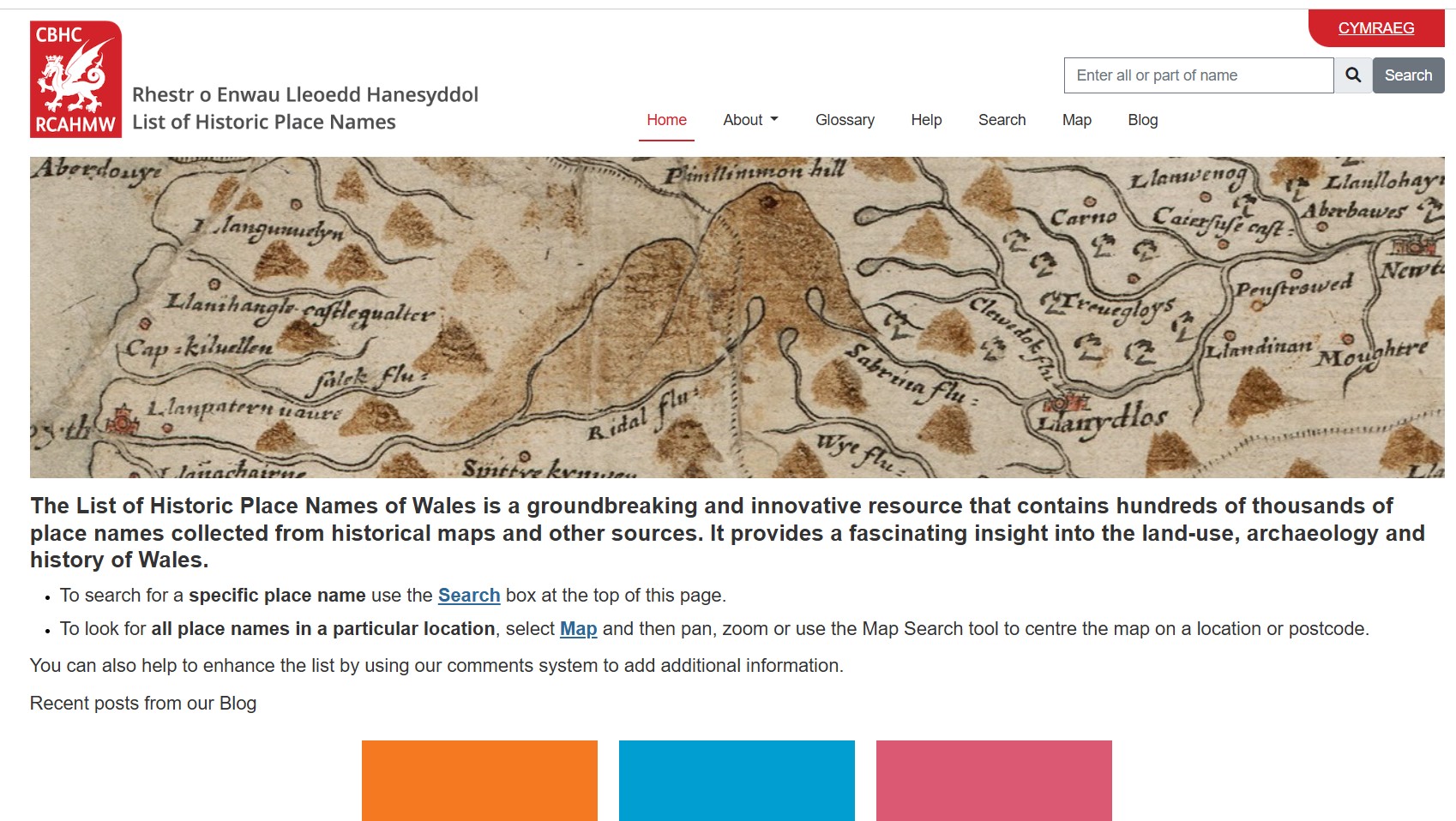
Visit https://historicplacenames.rcahmw.gov.uk/ to search or browse for hundreds of thousands of historic Welsh place names
Free Welsh Newspapers Online
Explore 15 million newspaper free on the National Library of Wales Welsh Newspapers site. Find useful family information such as family notices of births, marriages and deaths. Gain insights to bygone times through the advertisements, local and national news. And research events of importance to your ancestors' lives.
Welsh Journals Online
Explore what life was like in years gone by in this collection of 1.2 million journal pages (approximately three quarters of which are in Welsh; one quarter in English) at Welsh Journals (from the National Library of Wales). published between 1735 and 2007. Filter by name, place, year or journal title and search on any terms of interest to you to local publications to enrich your family and local history knowledge.
Welsh Family History Archive
Created by John Ball, Welsh Family History Archive is full of valuable information for family historians that’s difficult to find elsewhere. Highlights include a place name pronunciation guide, photographic images, a gazetteer of place names, gravestone inscriptions and a Welsh ancestor list, the latter created from information submitted by family historians.
Welsh Tithe Maps
Welsh Tithe Maps allows you to view 300,000 entries and their accompanying apportionment documents using present-day and historic maps. If your ancestor had a connection to the land, perhaps working as a farmer for example, you can find out more about the type and size of the land they owned.
How to find family history societies & associations in Wales
There are many different societies and associations to help you find out more about your Welsh ancestors, and many of these groups are members of the Association of Family History Societies of Wales. Here, you will find links to the different member societies.
The site also has an extremely useful list of Welsh parishes where you can look for a place name and find its pre-1974 and post-1974 parish name, as well as which family history society is applicable.
Welsh family history societies can also be found listed in the Family History Federation's find a society database. See also the FamilySearch Wiki covering family history, local history and one-name study societies in Wales.
Which family history society is best for you to join?
Societies welcome members from all around the world; you may wish to join a society local to you, if you are fortunate enough to live near one, so that you can attend their meetings and perhaps volunteer with their projects.
You may also like to join a society that covers the locality in which your ancestor once lived; doing so will mean you could benefit from, for instance, local specialist knowledge of the local area and families in the society journal, and also gain access to local transcriptions and indexes created by the society.
- Cardiganshire Family History Society
- Clwyd Family History Society
- Dyfed Family History Society
- Glamorgan Family History Society
- Gwent Family History Society
- Gwynedd Family History Society
- Montgomeryshire Genealogical Society
- Powys Family History Society
The Welsh People’s History Society
Formed in 1970, the Welsh People's History Society aims to promote and popularise the knowledge and study of all aspects of people’s lives in Wales.
- Membership is open to anyone with an interest in the history of Wales.
- The society organises day schools on various topics, as well as online talks, and also publishes its own scholarly journal.
- For the Welsh People's History Society, visit www.llafur.org
How to find museums in Wales
If you’d like to flesh out your research by exploring the lives and times of your Welsh ancestors, you’ll be spoilt for choice with the selection of museums across the country.
Perhaps the best known is St Fagan’s National Museum of History, billed as the most popular heritage attraction in Wales, and one of Europe’s leading open-air museums. The museum comprises more than forty re-erected buildings from various locations and time periods, including a chapel, tannery, schoolhouse and tollbooth.
The slate, wool and coal industries are explored at National Slate Museum (premises currently closed for redevelopment; but road trips displays happening through 2026), National Wool Museum and Big Pit National Coal Museum respectively. Each of these offer events and hold collections that can help you understand more about the work that your ancestor did. These are all part of the National Museum Wales group.
Find out more about Welsh history: watch and listen…
Welsh History Podcast - This weekly podcast broadcasts every Monday and aims to cover the entire span of the history of Wales, from the Stone Age through to the present day.
NLW YouTube channel - The National Library of Wales has a busy YouTube channel: with guides, interviews and talks.
Coflein - A catalogue of archaeology, buildings, industrial and maritime heritage. Search details of more than 100,000 sites, explore a catalogue of photos, drawings, manuscripts and digital resources, and browse the digital galleries.
Peoples’ Collections Wales blog - this blog brings together more than 150,000 photographs, oral histories and documents on topics including sport, religion, physical environment, industry, community and politics.
Dictionary of Welsh Biography - this is home to more than 5,000 biographies of people who made their mark on Welsh history over the centuries. You can browse by name or keyword and there is also an interactive timeline, to help place the lives into context.
Welsh Coal Mines - Coal mining was a major industry, especially in the south, and the ‘Welsh Coal Mines’ website has area-by-area links to individual coal mines under the ‘Collieries’ tab with details of each one from when it was originally sunk to its closure. Also within the left-hand strip is the link to the ‘List of Disasters’. Under this you’ll find a list of mining accidents with, in most cases, details of the fatalities by name.
Penmorfa - In north and mid Wales the slate industry was important and ‘The Slate Industry of North and Mid Wales’ at Penmorfa has a wide range of articles and many pages of photos which give an insight into the working lives of the men who laboured in the quarries. Many who lived in slate-mining villages during the first half of the 20th century can remember the clatter of the men in their clogs as they made their way to work each morning.
Welsh mariners - Before the coming of the railways journeys were often made by sea and with many Welsh counties having a coastal border this was often a source of employment. A great resource for Welsh family historians is the ‘Welsh Mariners’ website. There are currently more than 23,500 entries of Welsh Merchant Mariners searchable in the database of masters, mates and engineers. There is also a Royal Navy database of 3,000 men active in the Royal Navy from 1795 to 1815, including Welshmen at the battle of Trafalgar.
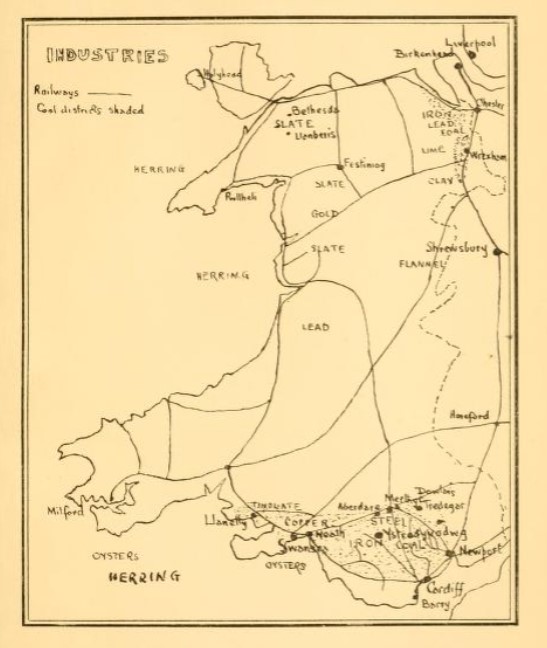
Map from A Short History of Wales by Owen Morgan Edwards, published 1907, and accessed via the Internet Archive
Useful Welsh words family history research
Professional genealogist Fiona Gray-Davies RQG (Ancestorseeker.co.uk) is here to help, providing useful Welsh words to aid with our understanding when researching Welsh family history.
It can be helpful to know a few Welsh words in order to understand family relationships in wills and when translating gravestones written in Welsh. Fiona Gray-Davies also provides advice on the Welsh patronymic naming system, and the impact on family history research, and also information about Welsh place names.
Welsh words for family relationships
In south Wales the word for grandmother is Mamgu but in north Wales it is Nain. Grandmothers also tend to be called by these names in Welsh-speaking families rather than a variation like Grandma as you would get in English. Grandfathers are known as Tadcu in south Wales and Taid in north Wales.
Some other family relationships are:
- Family - Teulu
- Wife - Gwraig
- Husband - Gŵr
- Mother - Mam
- Father - Tad
- Daughter - Merch
- Son - Mab
- Sister - Chwaer
- Brother - Brawd
Welsh words for days of the week
Monda - Dydd Llun
Tuesday - Dydd Mawrth
Wednesday - Dydd Mercher
Thursday - Dydd Iau
Friday - Dydd Gwener
Saturday - Dydd Sadwrn
Sunday - Dydd Sul
Welsh words for numbers
- One - Un
- Two - Dau
- Three - Tri
- Four - Pedwar
- Five - Pump
- Six - Chwech
- Seven - Saith
- Eight - Wyth
- Nine - Naw
- Ten - Deg
- Eleven - Un deg un
- Twelve - Un deg dau
Welsh words for months
- January - Ionawr
- February - Chwefror
- March - Mawrth
- April - Ebrill
- May - Mai
- June - Mehefin
- July - Gorffennaf
- August - Awst
- September - Medi
- October - Hydref
- November - Tachwedd
- December - Rhagfyr
Other useful Welsh words for family history
- Died - Bu farw
- Was born - Ganed/Ganwyd
- Was married - Oedd yn briod
- Aged… years - yn… mlwydd oed
- In memory of - Er cof am
- In loving memory of - Er serchog gof am
More details of words found on gravestones and other useful phrases can be found on the Clwyd Family History Society website.
Welsh place names & counties
Place names in Wales (or Cymru, in Welsh) can be written in Welsh or English and both are generally shown on road signs. The main towns and cities in Wales are as follows with their Welsh name in the second column and a translation in the third column. The six cities are asterixed.
- *Cardiff - Caerdydd - Fort on the Taff
- *Newport - Casnewydd - New castle
- *Swansea - Abertawe - Mouth of the Tawe
- Carmarthen - Caerfyrddyn - Merlin’s fort
- *Bangor - Bangor - A wattled enclosure
- *St Asaph - Llanelwy - Church on the Elwy
- *St Davids - Tyddewi - David’s house
English border counties like Herefordshire and Shropshire were not fully incorporated into England until the 16th century and until the 19th century many there spoke Welsh. As a result there are many towns in these counties with Welsh names. This also has a bearing on DNA results as Ancestry classifies ancestors born in the English border counties as Welsh.
From 1974-1996 the number of counties was reduced to 8 but this was unpopular and there are now 22 Welsh counties and county boroughs. Comparisons of county changes through time can be found on the FamilySearch Wales County Maps Wiki.
The significance of patronymic names
One major problem, when tracing forebears in Wales, is the prevalence of surnames such as Jones, Davies, Williams and Thomas. Never underestimate how many people share the same name but are not related. This is due to the patronymic naming system which existed in Wales where surnames were based on the father’s given name.
Ap or ab would be added between the child’s name and the father’s name for a boy, meaning “son of” and “ferch” for a girl meaning “daughter of”. So Robert, son of Richard would be Robert ap Richard and his sister Angharad would be Angharad ferch Richard. In the same way Angharad’s children would adopt their father’s forename as their surname.
Over time names were modified as the following examples show:
• “Ap” was dropped giving surnames such as Thomas or Morgan;
• “Ap” was dropped and an “s” added as with Williams and Richards;
• Ap John became Jones or John;
• Ap Harri/ap Harry would become Parry, or Harries (pronounced Harris);
• Ap Dafydd became anglicised to Davies (pronounced Davis) or David.
Patronymics lasted longer in the north and the central-west of Wales. The upper classes adopted surnames by the 18th century and by about 1837 patronymics had generally ceased and been replaced by these modified surnames.
Nicknames
In order to differentiate between those with the same name it was common to informally identify them by other means such as their occupation, initials, or by the name of the house or farm in which they lived.
So David Davies whose parents ran the local shop might be called Dai Siop (shop); Jack Jones from Penlan farm would be called Jack Penlan and the local milkman may have been called Jones the milk.
Welsh rugby players both called John Williams were distinguished by being called JPR Williams and JJ Williams respectively.
Strategies for searching popular names
Tracing those with popular names can be difficult so it is important to use alternative strategies to overcome this problem. Here are a couple of strategies which I have employed when researching:
Tip 1 – Trace forwards to go backwards …
Sometimes tracing the person forwards in time can provide information which helps you to trace them backwards.
Tip 2 – Look at siblings’ details & use DNA to corroborate
It is a good idea to look at siblings and other family members in order to find out which is the correct ancestor among several with the same name and also to look at DNA matches.
Tip 3 – Search broadly, and deeply
Other strategies are those, such as:
• to look at physical descriptions and occupations on military records;
• to use a large variety of documents rather than relying on just one;
• to identify all records in the area for that time period to ensure that there is only one person of that name;
• and to look at all names, including witnesses, on marriage records.
• When looking at christening records, establish that the child did not die in childhood and therefore cannot be your ancestor.
Emigration – seeking 19th C Welsh emigrants
A great many people emigrated to the USA from Wales in the 19th century – farmers initially, followed later by miners and tin workers. Tracing these ancestors can be problematic as, until 1908, Welsh passengers were recorded as English. Legally, any reference to England included Wales, so emigration records and statistics did not show Wales separately. The only categories available on passenger lists were “English”, “Scotch”, “Irish” and “Foreigners”.
For this reason, searching by name and nationality “Welsh” may not be successful. Passengers also sometimes described themselves by the job they were seeking in the US rather than by their actual job.
A solution to the passenger list problem
One way to overcome the passenger list problem is to look for the father in Naturalisation records, as a large number of Welsh migrants became US citizens. These records state the area of origin and often give the date of their crossing and ship name, enabling you to locate them in the correct passenger list.
Fiona Gray-Davies' general advice when researching Welsh ancestors
Although finding Welsh ancestors in the UK and abroad may be difficult for the many different reasons mentioned above, these difficulties can often be overcome by taking a different approach. Searching in more depth, tracing family units and using addresses, occupations and physical descriptions will often help you to discover which of the many possible candidates is likely to be your ancestor, and break down your brick walls, so don’t be discouraged!
About the Fiona Gray-Davies
Fiona Gray-Davies started researching her own family history 30 years ago in Wales, England and Scotland as she wished to find out the truth regarding family stories of connections to famous ancestors.
She discovered some were true and equally some were untrue and puzzling as to their origin. Fiona writes: “This piqued my interest generally in genealogy prompting me to undertake postgraduate academic study in the area when I retired from a career in accountancy. I obtained the MSc in Genealogical, Palaeographic and Heraldic Studies at the University of Strathclyde with Distinction last year. Since then I have enjoyed carrying out research into a number of genealogical projects.” Fiona is A member of the Register of Qualified Genealogists.
Notes: The material on this blog post was originally published in Family Tree (March 2019 and September 2025) and this blog was last updated 19th February 2025. Advice from Fiona Gray Davies was originally published in Family Tree (March 2025). With grateful thanks to Joanna Jeffery for providing the original inspiration for our coverage of Welsh family history resources.