



Are you looking for a way to share your family history findings with family and friends? Writing down your discoveries is a great way for relatives to enjoy your family history now, and in the future. Our step-by-step plan takes you from the planning stage through to a written family history you will be proud to share.
Everyone has a family history story they can tell, but many people do not think they have the skills to do it justice in a publication, writes Wayne Shepheard.
Frequently comments are heard such as, “I do not have any experience in writing articles” or “I’m not good at writing.”
Invariably, with a little help, most people can produce very good work because they have very good ideas to start with.
When it comes to writing genealogical stories, there are innumerable sources that advise on how to do it, what subject matter to use, the structure of the piece, etc.
🔎 Quick links: writing up your family history
- Why write up your family history?
- Deciding who your audience is
- Which format should I choose?
- What do you write about?
- Creating an outline for your story
- Choosing the structure
- Narrowing down the subject matter
- Your writing style
- Illustrating your family history
- Confidentiality
- Writing up your family history – a checklist
- Beating writer's block
- Useful websites to help you write up your family history
Why write up your family history?
When you consider publishing your stories, you first need to think about the reasons you want to write.
There are a wide variety of objectives or goals you might reflect on before you start. Probably what most of us are trying to accomplish is sharing what we have learned about the search for families in the past and preserving the information we found for future generations.
✍️ How to write your family history – free guide
We've put together a special booklet to help you write up your family history, featuring mind maps, family tree charts, ancestor fact files, interview sheets, planning sheets, and a publishing checklist.
Sign up to the Family Tree newsletter and we’ll send you this handy download-and-print guide completely free!
Get My Free Writing Guide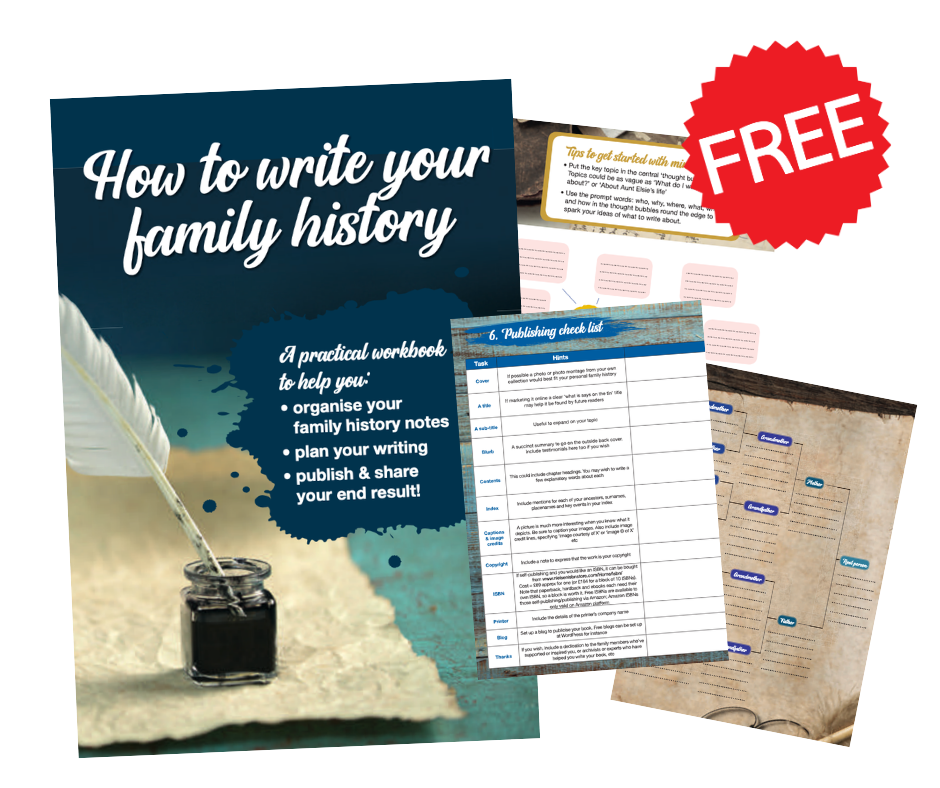
Deciding who your audience is
Decide up front who your readership might be as that may dictate the content to be included as well as the configuration of the piece.
For family members
Perhaps you only want to summarise information for family members. Or put the information you have gathered into a document that can be disseminated privately to relatives or other individuals. This might be in the form of a book detailing a whole family line or an article about one person or event.
For local society newsletters & journals
Belonging to a local genealogical society may offer opportunities to publish stories that other members will be interested in reading. In doing so you may learn from them, too, about further ideas for researching your family or the subject in general.
For commercial publications
Maybe you want to relate something to a wider audience, about some important people in your family tree or the methodology you used to find them. Commercial publications usually have more rigorous rules or guidelines for authors concerning the format, style, substance and length of a piece.
For presentations
Some stories make great subjects for presentations. Maybe you would enjoy sharing them with a live audience (in-person or online).
This is also a way to publish information, in this case verbally or in a recording saved for posterity and future viewing by others. Much of the same advice for writing articles applies to putting together a talk as there must be a narrative that goes along with the illustrations.
TOP TIP! Consider the context. If you’re writing for relatives, you can stick largely to featuring your own ancestors and their immediate environment, however in most instances (whether your audience comprises relatives or a wider readership), context is important for your story. By including the historical context you will help your readers understand the time period covered more fully. Context can take the form of written coverage of, for instance, major events or developments in the local area, items of national news, or information as to the life experiences of people in particular lines of work for instance.
Which format should I choose?
Then there is the aspect of format. Is the material intended for hard copy such as a book, a journal or magazine or will it be put into electronic form for a website, blog or newsletter?
Certain types of compositional structure may be more suitable for either print or digital presentation. Basic writing skills, style and organisation remain paramount, though, for any type of publication.
What do you write about?
What will you choose to write about? You probably have been researching your family history for years now and have uncovered a myriad of stories about people, events and places. This has been accomplished using many sources of information and different methods of putting it all together. You may also have learned about the regions in which your family lived, historically or physically.
Now you must look at that great amount of information or interesting ideas you have talked to others about and select parts that would be good for one or more stories or articles.
Timeline tip! You may find it helpful to start drawing up a timeline. On this you can include key dates from your family history, and key dates from local and national history too. You could use Excel, a simple list in Word, or even a large piece of paper to accomplish this.
Creating an outline for your story
A great idea, before you proceed with writing, is to list the points you want to make. Having an outline makes it easier to follow a logical framework and rearrange material if needed.
Individual points can be expanded and linked once a basic outline of what you want to say has been established. Part of this is to make each sentence, paragraph or sub-section lead into the next one so that everything flows nicely.
For longer articles, use headings or subheadings within the text to separate information or guide the reader through the article. If several major points are to be emphasised, break them into sections with titles.
Choosing the structure
There are, of course, many ways of telling the stories:
- As a compilation in narrative form of individuals in a family line across multiple generations
- As a narrative account but focused on specific events or people
- As an educational piece about research methodology or a region where ancestors lived
- As strictly information about records found or transcriptions of important documents
The structure may depend on the subject you choose and the audience you aim at.
Regarding the structure of a piece, make sure all the parts fit together properly in the entire piece so the reader can follow easily.
- Start with a brief introduction of the subject – even listing basic conclusions at the beginning – but get to the point quickly. Then the reader knows where you are going with this tale.
- Keep the main body of the text, including any subsections, on topic.
- Write a summary at the end bringing together all the results of the story/project or any problem that was solved.
This applies no matter how short or long an article is.
It is important to get the readers’ attention. Very simply, right off the bat:
- tell them what you are going to tell them,
- tell them,
- and tell them what you told them.
This methodology works very well for verbal presentations, too.
Narrowing down the subject matter
Whatever you decide to write about in a single article, it’s best to focus.
Don’t try to relate the history of the world or even your entire family. Don’t describe multiple events or do an exhaustive summary of many different methods of research. Pick and write about one topic of interest to you in a single article. If you are writing a book, then this advice applies to individual chapters.
Keep the message simple. Don’t include too much ancillary data about a myriad of people, places, activities or dates. Stay on point throughout and use language that is easy for anyone to understand.
Most important of all is to pick a story that interests you and which will be entertaining for others to read or hear.
💡 Top tip: hook the reader from the start!
A good way to start your story is to begin at an exciting moment. Opening with words such as ‘Alice Hemingway was born on 1 October 1940’ will do little to engage your reader. Instead, a few extra words to put that fact into context could make all the difference: ‘Alice Hemingway made her entry into the world on 1 October 1940, in a busy hospital which was struggling to operate during the London blitz'.
Your writing style
The way you write can be as important as what you write about.
The style you choose should offer information in a clear and understandable manner. Grammar, spelling, punctuation and structure – things most people learned in their early school days, are important too. They are there to help your work be intelligible. If people don’t quite understand what you are trying to say, they will stop reading, or at least they will never remember what you wrote.
Reference books
Different publications may emphasise the use of writing reference books. Explore the publisher’s website for details of their house style or enquire with the editorial team. A dictionary, thesaurus and publication manual are also recommended, such as New Hart’s Rules: The handbook of style for writers and editors (available in e-book, paperback and hardback versions). You don’t have to necessarily buy all these publications as information is available online.
Size and scope
Maybe you want to put something together about your family’s history for a talk and people have told you that it would make a great story for a journal or newsletter. It happens!
The first thing to recognise is that not all talks lend themselves to becoming a written article. More precisely, not everything in a talk needs to be or should be put into a single article.
If your presentation lasts 30 to 40 minutes, then you likely have a script, whether you wrote it all out or not, of over 10,000 words, maybe more. Thus, unless you are going to write a book, you will have presented a great deal more information than you will need for that two to six-page piece for a journal or magazine. To give you an idea of the extent of an article, a page in a journal or magazine, without an accompanying image, is about 500 words.
Illustrating your family history
Published material nearly always comes across better with illustrations. The images you choose should be relevant to your text. Remember to credit the source an image is obtained from, and check for any copyright or licensing restrictions, seeking permission where necessary.
💡 Advice on using images for your family story
What images are available to you? We all know that a 'picture tells a thousand words' and when writing family history material, images are no less important. You may be fortunate to have photographs of the relevant family members to include in your account. What do to if you don't, however? There are many other sources of images which will definitely engage the attention of your reader.
Source old postcards of the area, to see it as it was in times gone by.
Include historic documents that you have found. Remember that your reader may very well not be as familiar as you are with the records we use for family history, so be sure to include explanatory captions and annotations to help them understand what you're showing them.
Maps are always fascinating to pore over and provide evocative clues too, showing for instance how rural an area was in the past, perhaps.
Your family tree! Don't forget to include your family tree in your family history writing. If possible you could include the entire tree, or a link to an online version. If not possible, due to space restrictions, then don't worry. You can easily include excerpts from your tree of the relevant people and branches. While you are familiar with your ancestors' names, many of your family members may not be.
A tree will help them to keep track of the 'characters' in your account. As with the other images, include a helpful caption to help your readers orientate themselves and understand the way in which they are related to the people shown in the excerpt of the tree.
Confidentiality
When writing or talking about living people, it is necessary to use the utmost care regarding their privacy. It is wise to seek permission from those mentioned, prior to publication. In sensitive circumstances, you may wish to withhold people’s names, even in instances where they have given permission.
Keep a list of what you use!
It’s advisable to keep a list of books, articles and websites used in any article. Updating it as the writing process continues ensures that important references and citations will not be forgotten when it comes time to publish.
Citations
Always clearly state the source of information used, even for simple family stories. Whether you provide a list at the end of an article or provide formal footnotes or endnotes will depend on your audience. In your reference section, give full details about books, articles and the URLs of any websites from which information was located. Use quotations marks or italics to signify material copied or quoted from other publications and note its source.
Writing up your family history - a checklist
The comments presented in this guide are focused on writing about genealogical subjects, but they could be applied to almost any topic. To follow is a list to help you best direct your writings in the way that you wish.
- Write about things that interest you. That seems kind of self-evident, but writing is always easier if you have fun with it. Stories about family or personal experiences are the best places to start. As you write these stories you probably will also be inspired to look for more information to really flesh it out. Be sure to research all aspects.
- Write about things that you know about. If you have some knowledge or expertise about a subject, it may be useful to let others know. That might be in specific types of research, areas you have studied, time periods, individual characteristics such as occupations or military service. I have developed a niche regarding the impact of natural phenomena, or Mother Nature, on the lives and livelihoods of our ancestors.
- Be prepared to revise your work. Edit your work strenuously to prevent repetition and to clarify ideas. You may go through several drafts. Set your piece aside for a few days and then come back. You’ll find you have new thoughts or ideas on how to improve the pieces.
- Ask someone to proofread your work, especially someone who has writing experience, or an interest in the subject.
- Start a blog. This is a great way to practice writing as it allows you to focus on a single subject with each post. I started mine in August 2013 and have published over 400 posts. Blogs are a good way to communicate with friends and family about common ancestors and shared research interests. Over time you may find many individual blog posts can be expanded or connected into a large article that will be of interest to a journal or magazine with a broader audience. On my blog, Discover Genealogy (www.discovergenealogy.ca), 109 posts (27%) concern family members. Such short pieces together could form part of a full family history narrative.
- Contribute to local society journals and newsletters. Every society that has a newsletter or journal, no matter how sophisticated, is looking for contributions to fill their pages. You don’t have to be a member to submit an article, but you might wish to join. I have published 29 articles in seven family history society periodicals.
Everyone has a story. Please tell yours.
Wayne Shepheard has published over 60 genealogy-related articles and two books – ‘Surviving Mother Nature’s Tests’ and ‘Genealogy in the Little Ice Age’. He is particularly mindful about how changes to habitat and natural phenomena impacted our ancestors. www.discovergenealogy.ca

TEN TOP TIPS FOR GENEALOGISTS
Beating writer's block
Find out how to overcome writer's block with Natalie Pithers' top tips for genealogists who write a blog or write-up their family history.
Family Tree's regular blogger Paul Chiddicks says:
Have you ever considered writing a blog about your family history research? If not, why not give it a try? If you enjoy writing about your ancestors and the things that they got up to, why not share it with others in the form of a blog? I have only recently discovered the art of blogging myself, but with a little bit of help and encouragement it can help you grow your tree.
For those of you that are already blogging away, you will at some point hit the dreaded writer's block, but rest assured if you follow the tips below, you will soon be back to your creative best. This month I am introducing a very good friend of mine, Natalie Pithers, who has kindly agreed to help me out from my own writer's block moment.
Natalie has kindly written this month’s blog for you all to enjoy, so sit back relax and follow Natalie’s tips and guides, which will also help and inspire you, with new and creative ideas to grow your tree.
Ten ideas to solve writer’s block, by Natalie Pithers
I recently read a tweet from a fellow blogger asking for inspiration to help them break through their writer’s block. I think we've all been there! Whether you write a blog, or are trying to collate your research into interesting stories, we all get stuck for ideas sometimes. This got me thinking; when you are scratching your head for ideas, where can you look for inspiration?
1. Occupations
Whether you've a host of agricultural labourers in your family tree, or an eclectic mix of professionals, looking at our ancestor’s working life can provide great inspiration for your own writing. What was an average day at work like? What hours would they keep? How much did they earn? Was their work secure or precarious? Did they way in which they worked change over time? What effect did industrialisation have, or the digital age?
Have you already written about your ancestor’s working life? If so, why not write a guide to help others discover information about their ancestor's jobs?
2. Your peer group
What are your fellow genealogists writing about? Do you have the same experiences, or something different? What are your favourite blogs? That can be a discussion piece in itself! Is there a hot topic at the moment, or have you seen people asking similar questions to each other? Could you write an answer? Or perhaps explain why there is no easy answer?
3. What did you do today? What did your ancestors do on a typical day?
Think about what you did today, or this week. Maybe travelling to work, cooking lunch or managing the school run. Did your ancestors do any of those activities? Chances are they did - but perhaps very differently! Looking at everyday activities, and how they may have been done similarly or differently across the ages can be fascinating. Did your ancestor go to school? What was it like?
4. Food, glorious food!
I love food, and actually the history of food is really interesting. What type of lunch did your ancestors eat? Where did they get the ingredients? Have you tried any old recipes? Have you ever tried to eat like your ancestors? I'm thinking Ruth Goodman-style here! I keep planning to try to live for a month on World War Two rations... it would be an enlightening experience and a good blog post.
5. Tools
What websites, genealogy software, writing packages and note-keeping tools, do you use? Why? How? It's always great to hear about the tools that others find useful. Are you a spreadsheet whiz? Do you have a fantastic system for managing DNA matches? Please share! What about the records you've used to build your family tree? Could you tell others how to use them, or where they might find them?
6. Brick walls or success stories
Are you stuck? Why not tell the world about your brick wall, and the avenues you've taken to try to break it down. It might lead others to comment with new ideas. Similarly if you've solved a tricky conundrum, why not share it and help others learn to improve their research skills. We all learn new things from each other everyday, no matter how experienced we are.
7. Around the house
What was your ancestor’s home like? Their village, town or city? What about writing about the history of an everyday object? Sitting at the kitchen table - what would your ancestor’s furniture have been like? Did they even have any?! Who would have made it?
8. What's on the box?
Have you watched any really good (or bad!) history programmes recently? Or listened to any great (or terrible!) podcasts? Why not share your thoughts? Or perhaps you could do some further research and expand upon a topic touched upon in a popular show or documentary?
9. Flick through your photos
Do you have any favourite photos? Who is in them? What are they doing? Why do you like the picture? Could your photos inspire you to write something? What are the people in the photo wearing? Do you have a fond memory you'd like to share?
Perhaps you don't have a photo... perhaps it's a keepsake, an old chipped lamp with sentimental value, or a dazzling antique piece of jewellery? How did you come to own it and what is its story?
10. Pick a card…
Pick a random ancestor, it doesn't have to be direct.
- Who are they?
- Could you write about them?
- Or some element of their life or the time in which they lived?
- Or perhaps the place that they lived in?
- Are you lacking information on them? Why?
- What could you do to flesh out their life?
- Could you share those ideas with others?
- Why not try creating a mind map based on your ancestor, looking at everything from their name to their shoe size?
- Surely there is something on the map that inspires you?
I hope these ten tips help you to find inspiration and new ideas for fresh writing topics. If you've any great tips for finding inspiration then please share them with me on twitter @geneastories.
Useful websites to help you write up your family history
There are innumerable sources available for assistance in writing about family history topics.
A few that may be reasonable to look at in choosing the subject and organising the information are websites and blog posts offered by experienced family history writers, genealogy organisations and publishers. Such places to start looking include:
Cyndi’s List – Writing Your Family History: General Resources. www.cyndislist.com/writing/general
FamilySearch Blog – 18 Writing Tips: Tell Family Stories with Confidence www.familysearch.org/en/blog/18-writing-tips-for-2018-how-to-tell-personal-and-family-stories-with-confidence
Findmypast – Preserving the story of your ancestry: our expert guide to writing your family history. www.findmypast.co.uk/blog/help/writing-your-family-history
Genealogy Stories – Curious Descendants Club: How to go from boring to brilliant family history writing. https://genealogystories.co.uk/how-to-go-from-boring-to-brilliant-family-history-writing
Gil Blanchard. (2014). Writing Your Family History: A guide for family historians. Pen & Sword, 228 pp.
💡 Be aware of the impact your write-up might have
Don’t be afraid to include the ‘black sheep’ among your ancestors – people’s faults and failings are another way of bringing the story to life. IT can also be comforting, realising and remembering that our ancestors experienced difficulties, just as we do today.
Having said that, while there are many benefits of telling a 'warts and all' account, beware of including information which affects people who are still alive and could be upset by the family’s story. Very often the passing of time makes difficult chapters in the family story easier to hear. The right of living people to privacy and respect is paramount, however, particularly if you are writing your family history for wider dissemination, for instance on your blog or published in a family history book or article.
💡 Top tip: keep thinking of your reader!
Remember, not all of your readers will share your enthusiasm for dates, so ‘softer’ details such as local news, popular songs of the time and styles of dress will enliven the text.
Blog last updated 16 February 2026.