


Ahead of Family Tree's DNA Discoveries event running throughout March, we asked Family Tree newsletter recipients to share their views on using DNA for family history research, so we can better understand where the community is on its DNA journey and how best to support everyone. The results revealed some fascinating insights into how DNA is being used.
It’s no over-statement to say that DNA testing has revolutionised family history research, with millions of kits being sold and the data growing every day as more of us take a test.
But how are family historians using their DNA results?
How are we overcoming the challenges of understanding the data?
And are there still researchers who would prefer to stick to the paper records rather than science?
With our annual DNA Discoveries online event taking place in March, we asked Family Tree newsletter recipients to share your thoughts on DNA and reveal how (or if) it has helped your research, and the results have been intriguing.
DNA is widely used… but confidence is low
One of the clearest findings from the survey is just how widely DNA testing has been embraced by the family history community.
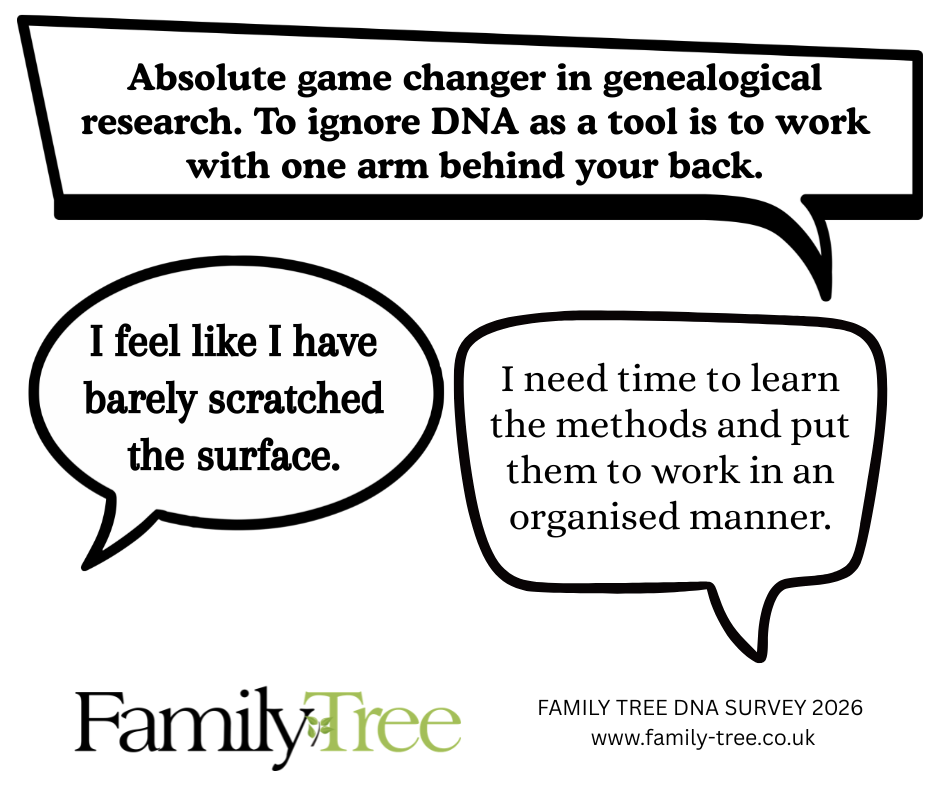
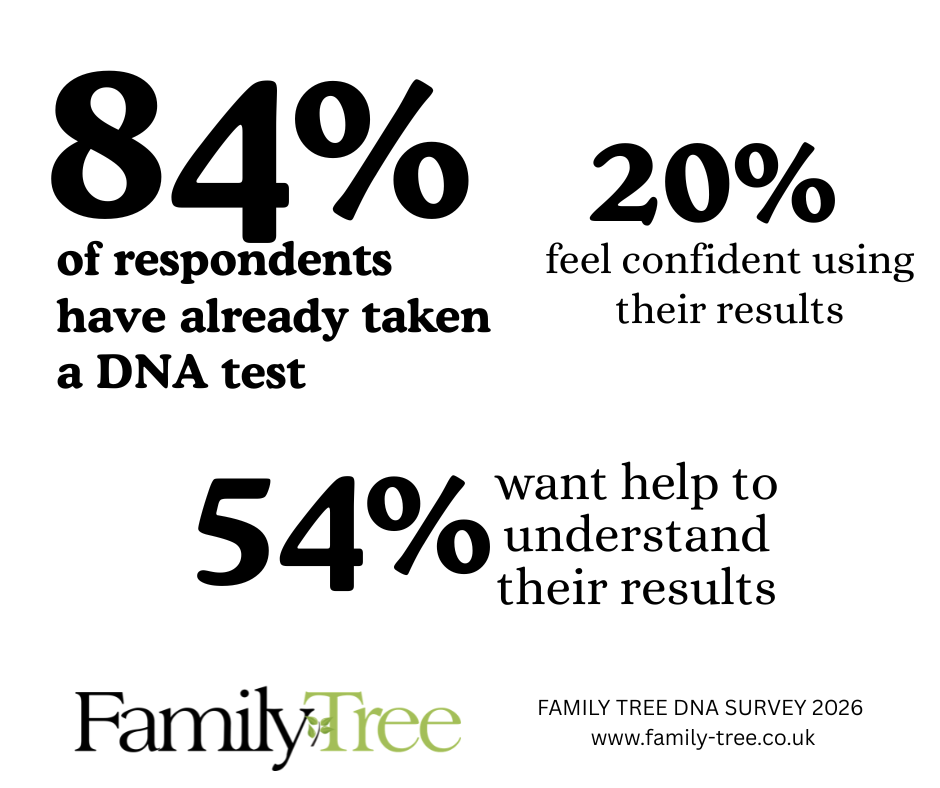
More than 84% of respondents said they have already taken a DNA test. It seems, for many researchers, DNA is no longer an optional extra but an expected part of the genealogy toolkit.
Yet taking a test is only the first step of the journey, and does not necessarily mean the results are quickly or easily understood; confidence in using the results is still low for many of us.
Only 20% of respondents described themselves as confident in using their results, while the largest group (54%) said they wanted more help understanding what their results mean and how to use them.
Of course, that’s where Family Tree’s advice on DNA comes into its own.
The first session in the DNA Discoveries series of talks will be a ‘A tour of your DNA results on AncestryDNA & MyHeritageDNA’ with our very own Karen Evans. This two-part webinar, taking place on 3 and 10 March at 6.30pm, will showcase match lists, specific tools for AncestryDNA and MyHeritageDNA, explain how to compare and contrast your match list, and will highlight hidden dangers we should all be aware of.
A strong appetite for learning about DNA
Encouragingly, the survey also shows an overwhelming desire to learn more, so we’re looking forward to many of you joining us for the online talks in March!
Almost 88% of respondents said they want to understand DNA testing and results better, while only 12% said they were not interested.
The survey also sheds light on who is using DNA in their research. Half of the respondents described themselves as ‘intermediate’ family historians, while 38% identified as ‘experienced’ researchers, leaving just 12% of DNA users who considered themselves beginners.
It therefore seems that DNA is being embraced most enthusiastically by those who already have a solid grounding in traditional research.
For many experienced researchers, DNA appears to represent the next step: a way to break through brick walls, confirm hypotheses, and uncover connections that documentary sources alone cannot reveal.
DNA is a tool, not a replacement
Another key insight from the survey is that DNA is rarely seen as a replacement for traditional research Instead, most respondents appear to view it as a complementary tool, one that works best when combined with documentary evidence.
This reflects the reality of modern genealogy: the most successful breakthroughs often come from blending DNA analysis with careful study of records, maps, newspapers and local history.
As DNA databases continue to grow and tools become more sophisticated, the potential for discovery will only increase. But unlocking that potential will require clear explanations, practical guidance and accessible education.
For family historians then, the message is actually reassuring: feeling confused about DNA is normal; you are not alone. And with the right tools and knowledge, those confusing results can become some of the most powerful clues in your research.
Expert talks to help you better understand DNA
Now in its third year, DNA Discoveries is a month-long celebration and exploration of genetic genealogy, presented by Family Tree and featuring some of the world’s foremost experts on DNA testing, research, and results.
Each talk is designed to tackle the issues so clearly seen in our survey, making DNA results easier to understand and use.
The full schedule for the talks is as follows:
- A tour of your DNA results on AncestryDNA & MyHeritageDNA with Karen Evans, 3 & 10 March, 6.30–8pm (UK time)
- A tour of Y-DNA with John Cleary, 12 & 19 March, 6.30–8pm (UK time)
- A tour of DNA Painter – demonstrations of 5 key tools with Donna Rutherford, 26 March & 2 April, 6.30–8pm (UK time)
You can come along to individual (two-part) sessions or save with the bundle ticket and attend them all.
Each session lasts approximately 1.5 hours and includes presentations, demonstrations, learn-along, and interactive elements. Optional homework may be set between sessions too, so you can really make the most of the expert guidance and improve your understanding.
The webinars will also be recorded and available to watch in your own time until 3 May 2026.
View the results of the Family Tree DNA Survey 2026 here (Word document, opens in new window)