



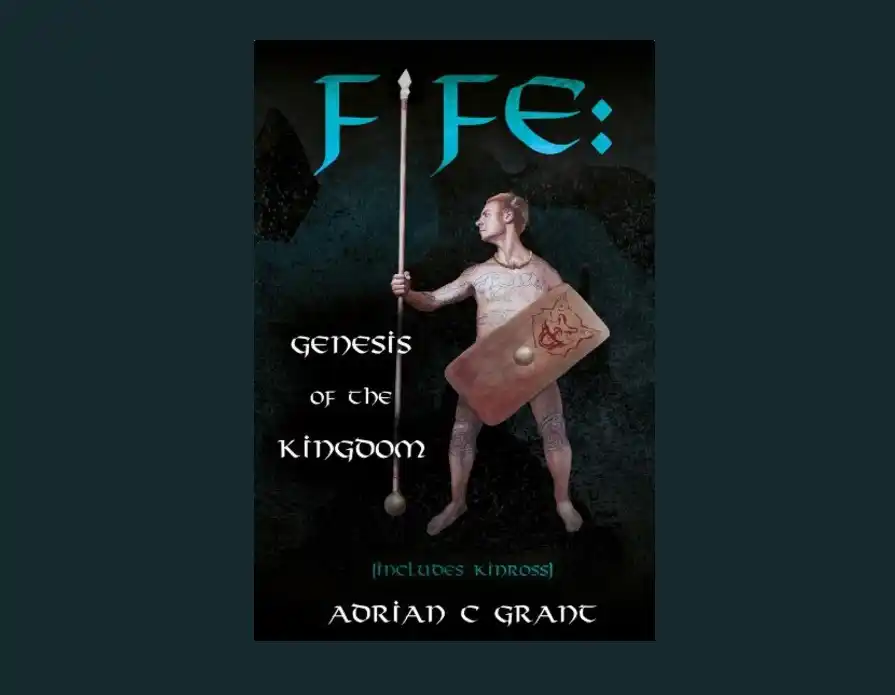
Sponsored post. Independent researcher Adrian C Grant's 352-page history looks anew at past conclusions drawn about the origins of Fife and invites us to reconsider
‘In most academic books the author normally never uses the word “I”,’ writes Adrian C Grant author of Fife: Genesis of the Kingdom, continuing: ‘such books are written on the assumption that so definitive is the work that there can be no argument, no alternative. In this work the reader may note that “I” is used a lot. This is not a matter of egocentrism: on the contrary it is rather to emphasise that this work is essentially speculative.’
As a family historian this point of view caught my eye; we are familiar with the notion that we are reflecting anew on material, seeking evidence, constructing hypotheses based upon these details, and it was from this aspect that I considered the book.
About Fife: Genesis of the Kingdom
Beginning in time period well beyond that with which I am familiar, Fife: Genesis of the Kingdom covers the period during which the area of Fife has been inhabited continuously – that is, since the Mesolithic period (about 6,300 BCE), and ‘the last time the ice retreated from our land’. Moving through the Neolithic and period of the Beaker people, Adrian C Grant brings us through to c200 BCE, when ‘north east Scotland experienced a new wave of immigration’, which ‘was almost certainly from the Low Countries and the immediate cause may have been a major flooding event caused as a prequel to a more general climate change which took hold around the year 150 BCE’.
The above was just the introduction, however, and the majority of the book covers the Romans and the arrival of the Caledonians and the establishment of Pictland, the impact of Christianity, then the Angles, Scots and Vikings.
It’s a detailed book that requires both contextual historical and geographical knowledge in order to full comprehend it. To this end the author has included 29 maps, a selection of informative colour plates, indexes to place names and person names, and a detailed timeline spanning:
- From ‘c6 300 Final retreat of ice-cap from Fife: people can move back in!’ (as mentioned above);
- To ‘1425 Murdoch Albany forfeits his lands. END OF THE EARLDOM OF FIFE’;
- And ’1426 Establishment of Kinrossshire as a separate entity.’
Looking ahead to 2030, Adrian C Grant also notes three significant anniversaries: the 1800th anniversary of the completion of the fort at Kirkcaldy, the 1000th anniversary of the appointment of Siward as thane, and the 900th anniversary of Duncan, grandson of Aethelred, being appointed as first Earl of Fife.
Key hypotheses
The nub of the argument and interest of the author focusses on the reinterpretation of the history of the Fife – particularly the extent to which successive peoples obscured the previous cultures.
‘The Scots not only destroyed our Pictish culture,’ writes Adrian C Grant, ‘albeit itself less than truly authentic – they also misrepresented themselves leaving us with very little; largely hiding their dependence on Irish mercenaries, they minimised our understanding of their impact which was so culturally devastating.
‘The Vikings left far more of a mark on and in Fife than Scots in particular have been happy to acknowledge and we are the poorer for our failure to embrace this.’
‘What I am offering here is my opinion about the best way that such facts as there are can be formed into a coherent narrative. Of course I will defend it all robustly but one should always expect the unexpected.’
Find out more about Adrian C Grant's research
Read Adrian C Grant’s papers, freely available at https://independent.academia.edu/AdrianGrant1
Fife: Genesis of the Kingdom (Troubador Publishing, 2024)
- Paperback, £19.99
- Ebook, £9.99, Amazon, Google Play and Apple Books
Review by Helen Tovey, published 4th December 2025.