


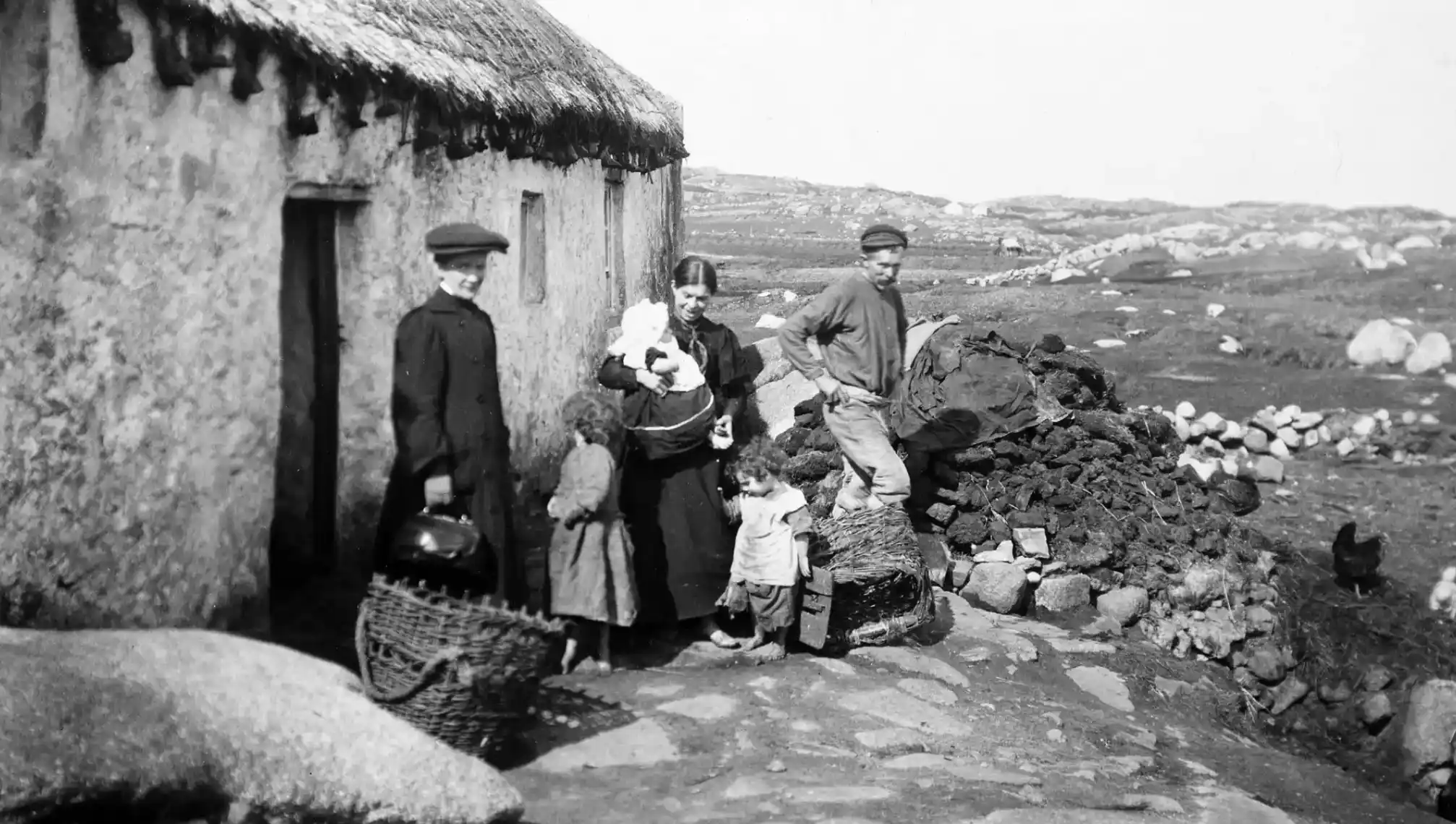
 A rural Irish family
Irish genealogy can be challenging, but it is far from impossible. This step-by-step guide to Irish genealogy explains how to trace your Irish ancestors using church registers, census substitutes, surviving census records, land records, and modern online resources – even when records appear to be missing.
Interested in Irish genealogy? Discover how to trace your Irish ancestors despite historical challenges such as the Great Famine, civil unrest, and the destruction of many records in 1922.
Learn about Irish genealogy records, church registers, censuses, online archives, and emigration sources to uncover your family history.
🔗 Irish genealogy quick links
- Irish genealogy and historical context
- Irish counties and administrative geography
- Core Irish genealogy records
- The 1922 Public Record Office fire
- Irish census records
- Irish birth, marriage, death and wills
- Key online Irish genealogy resources
- Northern Ireland ancestors
- Archives, libraries and local sources
- Specialist records and directories
- Planning a research trip to Ireland
- Emigration records
- Societies and associations
Irish genealogy and historical context
To make sense of your ancestors’ lives in Ireland and make a start on your Irish genealogy, it’s essential to understand the wider history.
Ireland was not divided into what would become known as the Irish Free State (later the Republic of Ireland) and Northern Ireland until after the Irish War of Independence. As a result, records created before 1922 are not divided north and south, and many collections cover the whole island.
Typically, nine out of ten people in Ireland were Roman Catholic, particularly during the period most family historians are researching. This affects where ancestors appear in parish registers and whether they appear in electoral registers.
The Great Famine (1845–49)
The Potato Famine occurred over 170 years ago, but its effects are still felt today.
- Ireland’s population before the famine was about 8 million
- At least 1 million people died
- A further 2 million emigrated in the decade following 1845
Many people researching Irish ancestry today are descendants of this Irish diaspora.
🇮🇪 Tracing Your Irish Ancestors – expert webinar series
Discover how to research your Irish roots with guidance from leading genealogy experts. This special webinar bundle explores Ireland’s history, records and the newly released 1926 Irish Census, helping you make meaningful progress with your Irish family history.
- 5 expert-led genealogy webinars
- Learn how to navigate Irish records and sources
- Understand Ireland’s geography and historical context
- Make the most of the 1926 Irish Census
Register now and attend all five expert webinars.
(Free to Family Tree Plus members)
Irish counties and administrative geography
Understanding Irish geography is critical to successful research.
Provinces of Ireland
The island of Ireland consists of four provinces:
- Ulster (North)
- Connaught (West)
- Leinster (East)
- Munster (South)
Counties of Ireland (32 in total)
- Connacht: Donegal, Mayo, Sligo, Leitrim, Roscommon, Galway
- Leinster: Monaghan, Cavan, Longford, Westmeath, Meath, Louth, Offaly (King’s), Kildare, Dublin, Laois (Queen’s), Wicklow, Kilkenny, Carlow, Wexford
- Munster: Clare, Limerick, Tipperary, Kerry, Cork, Waterford
- Ulster: Londonderry, Antrim, Tyrone, Down, Armagh, Fermanagh
There are:
- Around 2,500 civil parishes
- Around 1,000 Roman Catholic parishes
- Over 60,000 townlands
The townland is the smallest administrative unit. If you can identify your ancestor’s townland, you are extremely fortunate – it can pinpoint their origin to just a handful of dwellings and is invaluable for planning research trips, and for identifying ancestors in the records too.
FamilySearch Wikis: Explore the FamilySearch Wiki page for Ireland Genealogy. From there you will receive a fascinating overview of family history advice for researching in Ireland. Scroll down the Wiki page to the map - click on a county of interest to be taken through to the specific Wiki for that county. This will give you useful and precise information about what survives for that county, by record type and time period. Over on the right-hand column, click the links to the civil parishes and Catholic parishes, to obtain parish-specific information.
FindMyPast has a useful blog and video series explaining each county and associated records, including wills, service records, poor law records, cemetery indexes and census forms. Watch the guide, with Irish records expert Brian Donovan, below:
Core Irish genealogy records
The challenge of Irish records
When Irish records are mentioned, many genealogists think immediately of the 1922 fire. While devastating, not everything was lost, and many key sources survive elsewhere.
The 1922 Public Record Office fire
What happened?
On 30 June 1922, during the Irish Civil War, the Four Courts and the neighbouring Public Record Office of Ireland (PRO) in Dublin were destroyed by fire. Over 800 years of documents relating to Irish history and genealogy were lost.
The explosion could be heard 2km away, shattered windows on Grafton Street, scattered ducks in St Stephen’s Green, and caused widespread devastation.
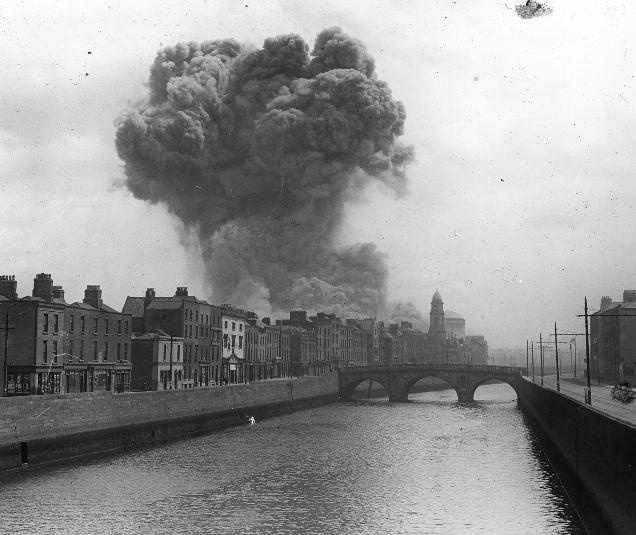
The PROI had been established in 1867 and had accumulated records dating back to the 13th century, including court records, probate records, Church of Ireland parish registers, and records of British administration in Ireland.
Aftermath and recovery
- Retrieval began on 17 July 1922
- More than 25,000 sheets of paper and parchment were salvaged
- Items were wrapped, labelled, and sorted at Dublin Castle
A 300-page manuscript compiled in 1919 by Herbert Wood - listing records held in the PRO - survived. It is often described as “the most depressing book in Irish history” because it catalogues what was lost.
What survived?
It is incorrect to assume that everything was destroyed.
Surviving material includes:
- Census fragments (1821–1851)
- Probate indexes and transcripts
- Church records (Catholic, Presbyterian, Methodist)
- Military and policing records held in the UK
- Records retained in Dublin Castle
The salvaged records (dating from the 14th–19th centuries) are held by the National Archives of Ireland and continue to be conserved.
Examples include:
- Roll of Attorneys (1785–1834)
- Writs of Summons (1894)
- Revenue Exchequer Accounts (1762–1789)
- Yeomanry returns (1798)
- Land certificates (1665–1668)
Virtual Record Treasury of Ireland
Launched in June 2022, the Virtual Record Treasury of Ireland is an all-island and international project aiming to reconstruct, virtually, the Public Record Office of Ireland.
Millions of words from destroyed documents have been reassembled from copies and transcripts held worldwide. These are presented within an immersive 3D reconstruction of the original building and are freely accessible online.
What do the major general family history websites provide for Irish research?
Of course, the major family history websites also provide a wealth of material for Ireland (subscription will be required to explore the records in full):
- Irish records at Ancestry
- Irish records at Findmypast
- Irish records at MyHeritage
- Irish records at TheGenealogist
See also the historical record collections for Ireland available via FamilySearch.
Irish census records
The Irish government conducted a census of the Irish population every 10 years from 1821 to 1911. However, the 1901 and 1911 censuses are the only complete surviving records accessible to the public. These censuses, covering the entire island of Ireland, were made available digitally in 2009.
A major research boon of the 1901 and 1911 Census returns is that the digitised images are freely searchable and viewable online. Search here.
Fragments of earlier censuses survive for 1821, 1831, 1841 and 1851.
The 1901 census was taken on 31 March 1901 and includes information such as:
- Name
- Age
- Sex
- Relationship to the head of the household
- Religion
- Occupation
- Marital status
- County or country of birth
The 1901 census also included information on each person's literacy and whether they could speak the Irish language.
The 1911 census was taken on 2 April 1911 and followed a similar format to the previous decade's survey.
However, the following additional information was added to the forms:
- The number of years the person had been married
- The number of children that had been born alive, and the number of children still living
The 1911 Census was the last to cover the entire island before the partition in 1921.
No census was taken in 1921 due to the Irish War of Independence, and the first census of the Irish Free State and Northern Ireland too was taken in 1926. (The 1926 Census for Northern Ireland has been lost however).
As the census records only become available to the public after 100 years, the 1926 census is set to available in 2026.
You can explore census records at the National Archives of Ireland, redesigned in February 2025, which also has details of census substitutes.
Partial census records for 1821 to 1851 survive too and can be found at FindMyPast.
Irish births, marriages, deaths & wills
The General Register Office Ireland is the central repository for Irish births, marriages and deaths from 1864 (non Catholic marriages from 1845). The Irish Genealogy website gives not only the index details but scanned copies of the full register pages.
General Register Office Northern Ireland (GRONI) holds records for the following in what is now Northern Ireland: births and deaths from 1 January 1864, non-Catholic marriages from 1 April 1845, all other marriages from 1 January 1864. You can see full details at NIDirect and then search online or at the Belfast search room.
Around two-thirds of pre civil registration records for the whole of Ireland - Church records - were destroyed in a fire in 1922. FamilySearch has a very informative guide to what church records are held where.
For pre-1870 parish registers (see this National Archives mircrofilm guide), explaining which Church of Ireland parish registers still exist. The National Library of Ireland has microfilms of surviving pre-1880 Roman Catholic parish registers for the whole of Ireland. Search church records online at the Irish Genealogy website.
Irish wills
For Calendars of wills 1858-1917 for all Ireland (or up to 1920 for the Republic of Ireland) can be searched on the National Archives of Ireland website. See also wills calendars for Belfast, Armagh and Londonderry at the NIDirect website.
Key online resources
Ask About Ireland is the home of Griffith's Valuation. This resource is particularly useful in light of the fact that so few census records survive.
You can see the dates when the survey for each county was completed on the Griffith's Valuation Wikipedia page, and these range from 1853 through to 1868. You can explore the Valuation at several places, including AskAboutIreland, which has transcripts, maps and original images, FindMyPast, Ancestry and RootsIreland.
The RootsIreland website provides information for all 32 counties of Ireland, providing details of census substitute records, BMDs, gravestones, passenger lists and more.
The census section of the National Archives holds original returns for 1901 and 1911 censuses. All 32 counties are available and can be searched from this site.
FindMyPast Ireland is home to millions of Irish records from the 13th century onwards. These include unique prison and court records, land and estate records, and a collection of 2 million Irish directories.
Visit Irish Genealogy for images of original registers for births 1864-1916, marriages 1870-1941, and deaths 1878-1966. You can also explore a large searchable record of pre 20th-century church records.
A website set up by John Grenham, author of Tracing Your Irish Ancestors contains a surname search feature which shows the distribution of particular surnames and their variations in Ireland at certain periods. There are also maps of civil and ecclesiastical parishes, along with summaries of the record collections available for each county.
You can also enhance your understanding of your Irish ancestors by using maps.
- Old Maps Online has beautifully digitised old maps to search, browse and zoom
- At Irish Townlands you can work down from county to parish and townland
- At John Grenham you’ll find a range of clear useful maps showing boundaries
Northern Ireland ancestors
Although Northern Ireland does not use the county system for administration anymore, you can still find useful records.
The Public Record Office of Northern Ireland (PRONI) holds records that can help you trace ancestors. These records cover the post-1836 counties of Antrim, Armagh, Down, Fermanagh, Londonderry, and Tyrone. They also include the parliamentary boroughs of Belfast and Londonderry.
These were established by the Grand Jury (Ireland) Act 1836.
Visitors can consult at the same location church records, Board of Guardian indoor relief registers, school registers, big estate collections, testamentary papers, Land Registry records, and name-heavy archives relating to the courts, prisons and hospitals.
Before visiting PRONI, we would recommend that you read this information leaflet on how to start tracing your family tree.
Due to the destruction of the Four Courts, PRONI has collected a substantial number of census substitutes. The most important of these are church records.
PRONI’s online catalogue contains details of over 1.5 million PRONI records. The catalogue can either be used for searching or for hierarchical browsing.
Online Northern Ireland records
A number of key collections have been digitised and are accessible online. These can be found under the subsection entitled Search Archives online. Online applications include the following:
- The PRONI historical map viewer which makes available six inch Ordnance Survey maps dating from 1832-1969. The maps are rich in detail and identify individual streets and houses.
- PRONI’s Valuation Revision books from 1864-1933 allow researchers to identify occupants for farms and properties across Northern Ireland. These should used in conjunction with the earlier Griffith’s Valuation which is available at Ask About Ireland.
- The PRONI wills index gives details of probated wills from 1858 onwards. Wills include information on the deceased (testator) and the property and goods they owned. Witnesses, beneficiaries and executors of a will (who are often related to the deceased) are also named.
- PRONI’s street directories application contains digitised copies of printed volumes listing names of individuals and/or businesses for 1819-1900. Most directories have details for Belfast and for the principal towns and villages in Ulster. The Belfast directories include an alphabetical listing of the principal inhabitants, merchants, shopkeepers etc. and their addresses; a listing of same by street and a listing of persons by profession and trade. The directories can be searched using Optical Character Recognition (OCR) functionality.
- PRONI’s Ulster Covenant application contains just under half a million original signatures and addresses of the men and women who signed the Ulster Covenant or corresponding women's Declaration on 28th September 1912.
Visiting PRONI
PRONI moved into its current premises in the Titanic Quarter area of Belfast in 2011. Access is free however visitors need to produce proof of identity, eg a passport or driving licence. Users are permitted to copy many records using their own cameras/phones/tablets, though you can still pay for digitised copies upon request.
Public Record Office of Northern Ireland, 2 Titanic Boulevard, Titanic Quarter, Belfast BT3 9HQ; tel: 02980 534800.
Archives, libraries and local sources
Local repositories often hold:
- Street and trade directories
- Cemetery registers
- Maps and valuations
- School rolls
- Workhouse records
- Family papers
County libraries and archives are run by local councils and often provide online resources.
Throughout Ireland there is a network of local libraries and archives. Most Irish counties on both sides of the border have their own dedicated county library and archive which are run by local councils. Larger cities such as Cork and Dublin have more than one library and archives.
When looking for ancestors in a county in Ireland, check if the county library and archives have online resources. These resources may help you in your search.
The head library for each county or city will likely contain books on local history, old newspapers, reference works and journals published by local historical societies, etc.
- Situated on Dublin's Pearse Street, the Dublin City Library and Archive has church records, civil and census records, land records (including Griffith's Valuation) and indexes of births, marriages and deaths up to the 1950s.
- The General Register Office of Northern Ireland is responsible for the civil registration of births, marriages and deaths for Northern Ireland. You can use its services online by registering on the website. The GRO holds all local register books for Northern Ireland from 1864 (for births and deaths) and from 1922 (for marriages). It has also has records of birth, marriage and death for Northern Ireland (Antrim, Armagh, Down, Fermanagh, Derry (Londonderry) and Tyrone).
- Public Record Office of Northern Ireland (PRONI) in Belfast is a key resource, as the official archive for Northern Ireland. At the time of writing (summer 2021) admission is my appointment only. The record office has a range of archives for local and family history, including maps, estate records, school records, church records and public and private records. Find links to these on the PRONI website.
- Situated on Bishop Street in Dublin, National Archives of Ireland is, at the time of writing, open to the public by appointment only. Here, you can explore tithe appointment records for the 1802s-30s, the 1901 and 1911 census returns and valuation records for the 1840s-60s. Please note the Archives does not hold civil records of births, marriages and deaths.
- The National Library of Ireland, on Kildare Street, Dublin 2, has many resources for family historians, including Catholic Parish Registers, property records, directories and heraldic records. Visit the National Library of Ireland website for advice on using the library's records for genealogy.
- Based at the Irish Life Centre in Dublin, the Valuation Office has a manuscript archive containing rateable valuation information of all property in the state from mid 1850s until the early 1990s. This acts as a 'census substitute' from the 1850s through to the first useable census in 1901, as it can be used to show who occupied a particular property over the years.
Specialist records and directories
Street and trade directories of the principal cities and towns in Ireland are invaluable sources of information for researching family history.
Earlier directories often concentrated primarily on the larger businesses and institutions. As time went on, the information contained became more detailed, with adverts for individual businesses, images, and descriptions of various trades.
Irish workhouse records
The workhouse looms large in Irish history, particularly in relation to the Great Famine and its immediate aftermath. Workhouses were introduced to Ireland in the early 1840s and continued to function up until the 1920s. There were 163 workhouses in total throughout Ireland.
Along with being a place of last resort for those who had become destitute, workhouses were also a place for assisted emigration.
Surviving workhouse registers are often kept locally. Unfortunately, not all records for every workhouse survive.
For Cork, minute books (recording the proceedings of Board of Guardians’ meetings), are the largest series of poor law archives that have survived; workhouse registers, financial accounts and correspondence and several other series also survive for some areas.
To discover which poor law union your Irish ancestors may have resided in, you can check the map of Irish poor law unions at the The Workhouse website.
Planning a research trip to Ireland
Local archives and libraries are an essential source for family history research. If you are planning a trip to Ireland to research your ancestry, then they should be high on your list of places to visit.
Aside from these public-run archives and libraries, there are also other special archives run by Irish religious orders or specific businesses, such as breweries. The Archives and Records Association of Ireland (ARA) has a useful listing of local and specialist archives throughout Ireland and Northern Ireland. They might just help you get through some of those stubborn brick walls.
Emigration records
Passenger lists can be valuable for tracing Irish emigrants.
The National Archives and Records Federation holds Irish Famine emigration records (1846–1851), documenting over 600,000 arrivals in New York – around 70% listing Ireland as their home country.
Search emigration records via TheGenealogist, FindMyPast and Ancestry.
Irish genealogy societies and associations
The Genealogical Society of Ireland GSI is for anyone interested in Irish family history. It runs a busy programme of publications, lectures, meetings, archival and scientific research, and database creation. The society meets twice a month and members also stay in touch via a newsletter and annual journal.
The Irish Genealogical Research Society celebrates its centenary in 2026. To see the valuable and unique collections held in its library, explore the Library Holdings page.
An Daonchartlann/Archive is an advice and help centre at Loughlinstown, offering expert help to visitors.
Originally known as the Huguenot Society of London, the Huguenot Society of Great Britain and Ireland has a dedicated Irish section with its own website. The Irish section arranges events, lectures, walks and meetings, and an AGM - usually held in May or June each year. There is also a Huguenot Archive in Dublin, which is open to the public and to members by arrangement.
The Irish Family History Society was established in 1984 and is open to anyone interested in tracing their Irish roots. The group promotes the study of Irish family history and genealogy through its annual journal, news sheets, lecture series and projects. It also encourages the repatriation of overseas material on Irish emigrants.
Founded over 40 years ago and with particular reference to the nine counties of Ulster, the North of Ireland Family History Society has eleven branches, plus a research centre in Newtownabbey, Co Antrim.
The society runs more than 100 events each year and also offers a range of courses, from beginner to advanced. Members receive a newsletter and copies of the journal North Irish Roots, plus access to the member section of the website, which has resources such as maps and articles.
Get more family history advice with the Family Tree newsletter
Sign up to receive the Family Tree newsletter and we'll send you a friendly, informative weekly email packed with expert tips, advice and special offers. As a welcome gift we'll also send you a resource kit featuring interview sheets, family tree charts and more!